
Overall construction activity
Total employment showed stable growth during the period. Employment rose from 467,000 workers in 2022 to 492,000 in 2024 and the estimate for 2025 is around 505,000. This indicates a strong labour market and continued economic expansion. The increase in employment is partly connected to the growth of construction activity, tourism, real estate, and services.
Industry employment, including construction, increased from 42,000 employees in 2022 to 44,000 in 2024, with forecasts suggesting further growth to 48,000 in 2025. This reflects the continuing importance of construction and industrial activities within the Cypriot economy. Rising employment in construction is linked to higher demand for residential developments, infrastructure projects, and commercial buildings across the island.
At the same time, unemployment declined steadily over the period. Total unemployment, including construction-related unemployment, decreased from 31,000 people in 2022 to 25,000 in 2024 and is estimated to fall further to 23,000 in 2025. This reduction indicates improving economic conditions and stronger labour demand. The construction industry has contributed significantly to job creation, particularly for skilled workers, engineers, technicians, and manual labourers.
Overall, the data confirm that Cyprus has experienced positive labour market developments in recent years. Rising employment levels and falling unemployment support continued expansion in the construction sector. However, labour shortages may become an increasing challenge for the industry as demand for workers continues to rise.
Specifically, construction employment stood at 37,000 workers in 2022 and the 2025 estimate is 42,000. Self-employed workers were about 5,000 in 2022 and the estimate was around 6,000 workers in 2025.
Figures are not available for 2026.
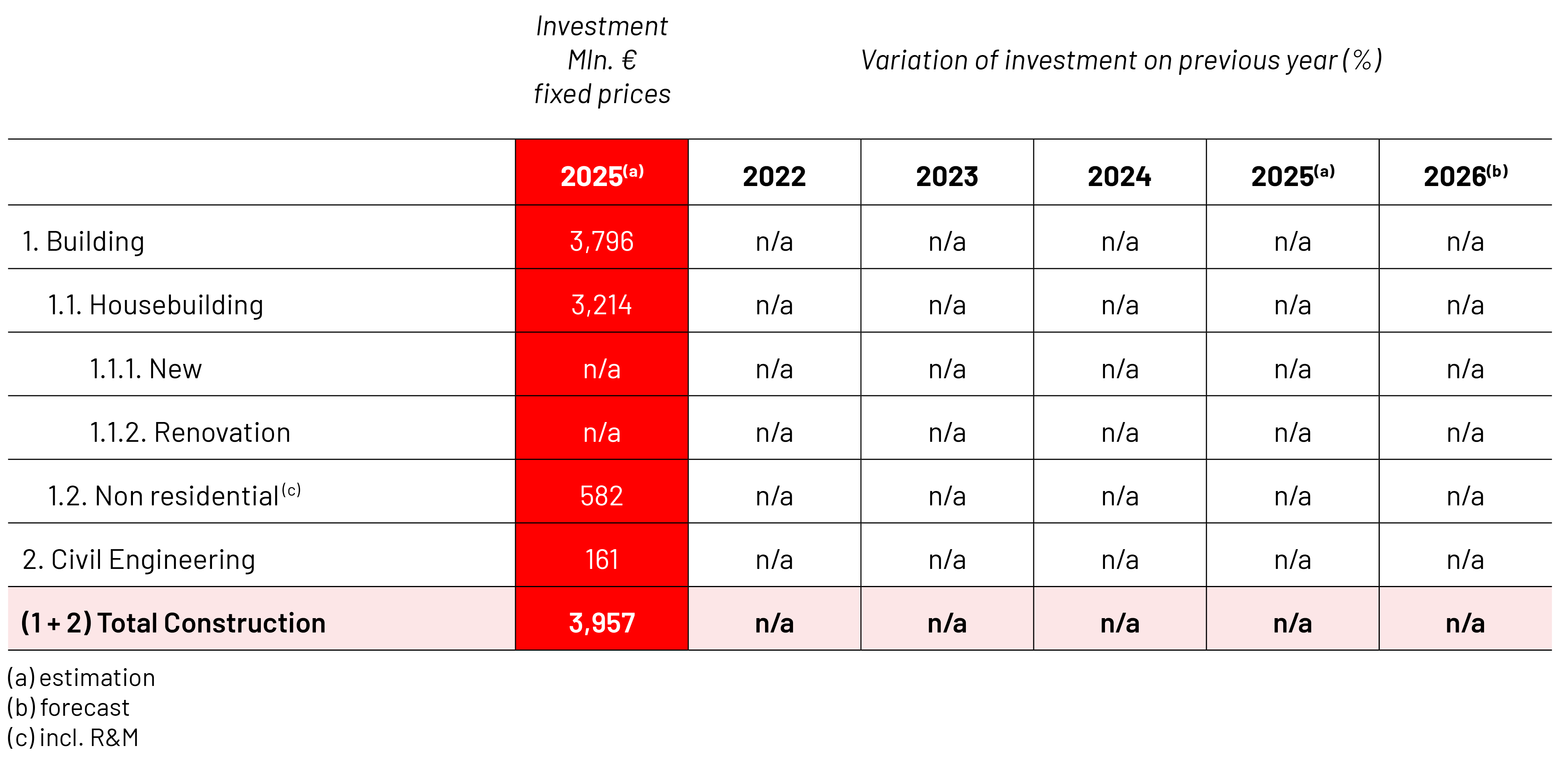
The table illustrates the development of construction output in Cyprus at current market prices between 2016 and the estimation for 2025. The figures show substantial long-term growth in the construction sector, despite temporary declines during periods of economic uncertainty.
Total construction output increased significantly from approximately €1.1 billion in 2016 to €3.96 billion in 2025. This demonstrates the strong recovery and expansion of the Cypriot construction industry over the past decade. Although activity declined during 2020 and 2021 due to the economic effects of the COVID-19 pandemic, the sector recovered rapidly in the following years.
The construction sector reached a peak in 2019 before declining during 2020 and 2021 because of the pandemic and global economic disruptions. Nevertheless, recovery began in 2022 and accelerated strongly in 2023–2025. The projected increase to almost €4 billion in total construction output in 2025 (estimation) highlights the continuing strength of the industry.
Overall, the data confirm that construction remains a key driver of economic growth in Cyprus. Residential development continues to dominate the sector, while non-residential and civil engineering projects also contribute to long-term economic expansion and infrastructure modernisation.
Housebuilding
Housebuilding remains the dominant component of the construction sector. Residential construction increased from €857 million in 2016 to approximately €3.21 billion in 2025 (estimation in 2025). Strong demand for housing, foreign investment in real estate, urban expansion, and tourism-related migration have supported this growth. The particularly sharp increase between 2018 and 2019 reflects the rapid expansion of residential developments, especially apartment projects in cities such as Limassol and Nicosia.
Non-residential construction
Non-residential construction also experienced considerable growth during the period. Output rose from €239 million in 2016 to an estimated €582 million in 2025 (estimation in 2025). This category includes offices, hotels, retail developments, educational facilities, and industrial buildings. The increase is closely connected to tourism investment, commercial expansion, and the relocation of international businesses to Cyprus.
GDP 2025
BILLION
POPULATION 2025
Total investment in construction in 2025
BILLION
Civil engineering
Civil engineering activity showed more moderate but still important growth. The value of civil engineering projects increased from €20 million in 2016 to approximately €161 million in 2025 (estimation in 2025). Public infrastructure projects, road improvements, utility systems, and energy investments contributed to this development. However, the data also indicates fluctuations from year to year, reflecting the irregular timing of major infrastructure projects.
Prices of construction materials
The table presents the price index development of major construction materials in Cyprus between 2023 and 2025, using the first quarter of 2023 as the base period (Q1 2023 = 100). The data highlights significant differences in price movements among steel, cement, bitumen, and wood, reflecting changing market conditions and supply costs within the construction industry.
Steel prices recorded the largest decline during the period. Starting from the base index of 100 in the first quarter of 2023, steel prices fell steadily to 75.97 by the fourth quarter of 2023. The downward trend continued throughout 2024 and 2025, reaching approximately 65.62 by the final quarter of 2025. This decline may be explained by easing global supply chain pressures, lower international steel demand, and stabilization of energy prices after the sharp increases experienced during previous years. Lower steel prices can reduce construction costs for structural projects and large-scale developments.
In contrast, cement prices increased considerably over the same period. From the base index of 100 in early 2023, cement prices rose continuously to 111.28 by the end of 2023. The upward trend accelerated further during 2024 and 2025, with the index reaching approximately 116.70 in 2025. The sustained increase in cement prices reflects higher production and transportation costs, particularly energy expenses, which strongly affect cement manufacturing. Rising cement prices contribute directly to higher overall building costs in Cyprus because cement is a fundamental material in residential, commercial, and infrastructure construction.
Bitumen prices showed moderate fluctuations during the observed period. After declining slightly during 2023, prices increased again during 2024 before stabilizing in 2025 at around 101.04. Since bitumen is closely connected to oil prices, changes in global energy markets and transportation costs have influenced its price development. Stable bitumen prices are important for road construction and civil engineering projects.
Wood prices declined gradually between 2023 and 2025. The index decreased from 100 in the first quarter of 2023 to approximately 91.85 by the end of 2025. This trend suggests improving supply conditions and reduced pressure in international timber markets following the sharp price increases experienced during the pandemic years. Lower wood prices may help moderate costs for residential projects and interior construction works.
All the above index prices are estimated for the year 2025.
Overall, the data demonstrates that construction material prices in Cyprus remain volatile and vary considerably by material type. While declining steel and wood prices may provide some relief to developers and contractors, rising cement prices continue to place upward pressure on total construction costs. These price developments have a direct impact on project profitability, housing affordability, and investment decisions within the Cypriot construction sector.
Business registration and bankruptcy
The figures for Business registration and bankruptcy for Cyprus are not available.
Construction Activity