Overall construction activity
After a difficult period, Estonia’s economy stabilised in 2025. Real GDP increased slightly from EUR 28 945,7 million in 2024 prices in 2024 to EUR 29 114,8 million in 2025, while construction gross value added in constant prices declined from EUR 1 430,4 million to EUR 1 382,6 million. Total construction investment in constant prices fell from EUR 3 297,0 million in 2024 to EUR 2 620,0 million in 2025. Construction employment remained relatively stable at 51,8 thousand persons, compared with 52,3 thousand in 2024. In 2026, a gradual recovery is expected: real GDP should grow by about 2,1%, and total construction investment is forecast to rise to around EUR 2 690,4 million in constant prices, with employment edging up to 52,2 thousand.
Housebuilding
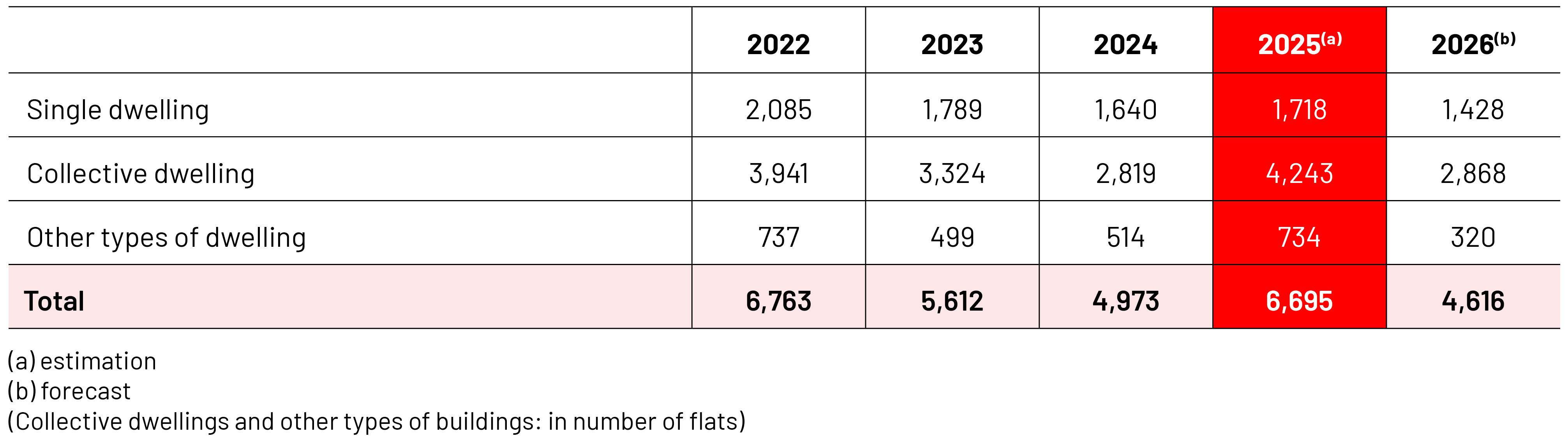
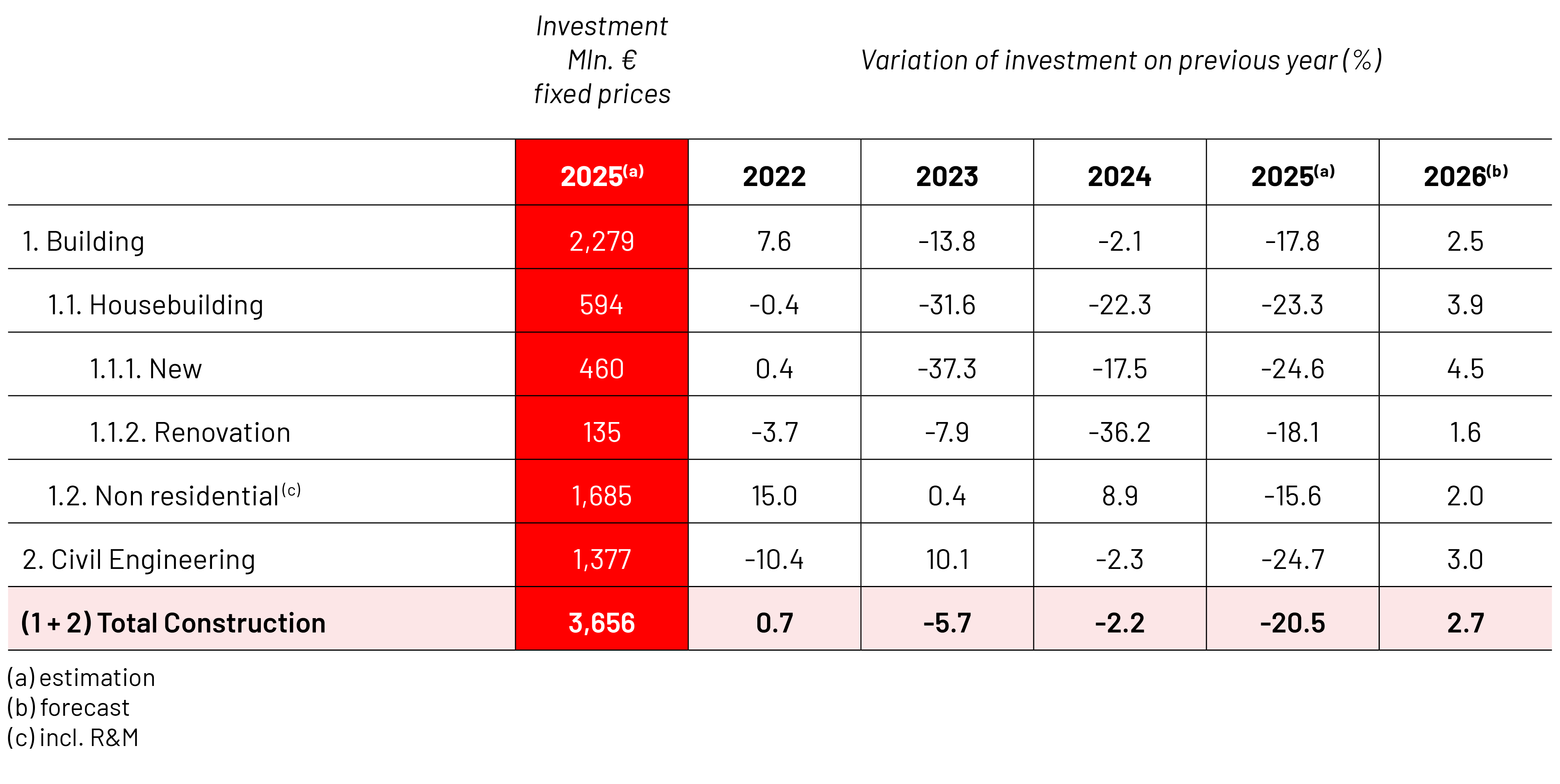
Housebuilding remained the weakest segment. In current prices, residential construction decreased from EUR 762,7 million in 2024 to EUR 593,9 million in 2025, while new housebuilding dropped from EUR 600,9 million to EUR 459,5 million. Higher financing costs, cautious households and low developer confidence continued to hold back demand. At the same time, the pipeline improved: residential permits increased from 4 973 dwellings in 2024 to 6 695 in 2025, while starts reached 4 911 dwellings. For 2026, only a modest recovery is expected, starting from a very low base. Residential renovation was more resilient than new housebuilding in 2025, partly supported by public energy-efficiency grant schemes for apartment buildings and small residences, though the segment is expected to recover only gradually in 2026.
Non-residential construction
Non-residential building activity was more resilient than housing, but it was still subdued. Current-price investment is estimated at EUR 1 684,8 million in 2025, compared with EUR 1 968,1 million in 2024, while the constant-price level stood at EUR 1 207,6 million. Office, logistics and industrial projects continued selectively, but private investment decisions remained cautious. In 2026, a gradual improvement is expected as the wider economy strengthens.
GDP 2025
BILLION
POPULATION 2025
Total investment in construction in 2025
BILLION
Civil engineering
Civil engineering weakened in 2025 after a relatively strong previous period. Investment is estimated at EUR 1 376,8 million in current prices and EUR 986,8 million in constant prices, against EUR 1 802,3 million and EUR 1 310,8 million respectively in 2024. The decline reflects the uneven timing of infrastructure projects. Civil engineering should be a relatively supportive segment in 2026, driven by Rail Baltic’s full-scale construction phase and four-lane highway works on major corridors.
Prices of construction materials
Construction input prices remained relatively contained overall, although the picture differed by product group. Using Q1 2023 = 100, by Q4 2025 wood stood at 103,7, steel at 93,3, cement at 88,9 and bitumen at 75,1. According to Statistics Estonia, the overall construction price index increased by 1,5% in 2025, mainly due to higher material costs. In 2026, price pressure is expected to remain moderate.
Business registration and bankruptcy
Business demography was comparatively stable. The number of registered construction enterprises increased from 2 069 in 2024 to 2 242 in 2025, while bankruptcies fell from 28 to 14. This suggests that market entry remained active despite weak construction volumes, whereas insolvency pressure eased after the deterioration seen earlier. In 2026, registrations should remain solid, but competition and margin pressure will stay high.
Construction Activity
Number of building permits in residential construction